
The Product Page: The Heart of Any Online Store
Your ads may attract visitors and drive traffic to your website, but if your product page isn’t well designed, customers will stop at browsing and never click “Add to Cart.” That’s why effective product pages are essential tools for turning visitors into paying customers.
In this article, we’ll break down how to create product pages that boost conversion rates, explore global success stories, review key consumer behavior statistics, and share practical tips backed by trusted sources.
Why Is the Product Page So Important?
The product page is where the customer makes the final decision: “Will I buy or not?”
According to Shopify, product page design is the most important factor in conversion rate. Some studies show that optimizing product pages can increase sales by up to 30%.
Key Elements of a Successful Product Page
1. High-Quality Images
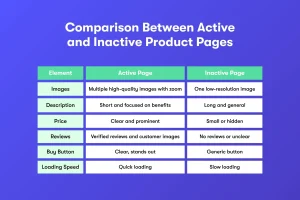
Images are the first thing customers see. According to BigCommerce, 78% of shoppers want multiple product images before making a purchase decision.
Example: Apple showcases products with ultra-high-resolution images from multiple angles, with zoom options for details.
2. Compelling Product Description
Keep it short, scannable, and focused on benefits, not just features. Instead of “100% leather shoes”, write “Comfortable natural leather shoes designed to support you all day.”
According to Nielsen Norman Group, customers prefer concise, benefit-driven text.
3. Clear Pricing & Discounts
The price must be visible and prominent. Adding limited-time offers or bundles can drive purchases.
Example: Amazon uses “limited-time discounts” to encourage fast decisions.
4. Reviews & Customer Feedback
Over 90% of customers read reviews before buying (BrightLocal). Displaying positive reviews—and responding to negative ones—builds trust.
Example: Sephora showcases customer reviews with photos after product use.
5. Clear Call-to-Action (CTA) Button
Your “Add to Cart” or “Buy Now” button must stand out with color and design. According to CXL, changing the CTA color alone can increase conversions by 6–10%.
Advanced Strategies for Optimizing Product Pages
1. Use Video
Short videos can boost sales by up to 80% (Insivia).
Example: Nike uses videos of people wearing its shoes during workouts.
2. Improve Page Speed
According to Google research, 53% of users abandon a page if loading takes longer than 3 seconds. Optimize images and code for fast performance.
3. Optimize for SEO
Use keywords in product titles and descriptions. Add alt text to images to increase search visibility.
Example: Zappos ranks high in search results thanks to keyword-rich product descriptions.
4. Recommend Related Products
“Customers also bought…” or “You may also like…” suggestions can lift average order value by 10–30% (HubSpot).
Global Examples of Effective Product Pages
-
Apple: Elegant, image- and video-focused design with short benefit-driven descriptions.
-
Amazon: Relies heavily on reviews and personalized recommendations.
-
Sephora: Builds trust through customer reviews and real-life product photos.
-
Nike: Uses short lifestyle videos to show products in action.
Practical Tips for Effective Product Pages
-
Keep the design clean and distraction-free.
-
Focus on benefits instead of just technical specs.
-
Add authentic customer reviews with photos.
-
Test different button styles and colors (A/B Testing).
-
Ensure fast loading and seamless mobile UX.
The Future of Product Pages
With AI, product pages will become smarter and more interactive. Expect to see:
-
Real-time personalized recommendations based on visitor behavior.
-
AI-generated visuals showing the product in styles that match each user’s preferences.
According to Forbes, AI will soon be an integral part of the shopping experience.
Conclusion
A product page isn’t just a place to show a picture and price—it’s a complete persuasion tool. With high-quality images, compelling descriptions, customer reviews, and a clear CTA, any online store can double its sales.
When combined with advanced strategies like video, page speed optimization, and AI personalization, the product page transforms from a storefront into a conversion engine.
Explore Bowaba’s digital marketing services and start building product pages that sell!